

During manufacturing processes, when using water-soluble cutting fluids, there are times when the tank suddenly becomes covered with foam, or something just feels off. While it’s easy to dismiss it as “just a pump pressure issue,” the real causes are often far more complex—ranging from the cutting fluid’s composition to environmental factors and even subtle signs of microbial degradation. Many of you may wonder how to deal with such issues and what solutions are available. The good news is, with a bit of attention, they can often be resolved effectively.
In this post, we’ll explore the reasons behind foaming and how to manage it.

💧 What Is the Key Ingredient in Cutting Fluids That Causes Foam?
Water-soluble cutting fluids are composed of various chemical components such as surfactants, lubricants (esters, mineral oils, etc.), rust inhibitors, defoamers, preservatives, and antimicrobials.
Among these, surfactants are most directly linked to foam generation. Normally, oil and water do not mix. However, surfactants enable stable emulsification between the two. The downside? Just like soap, they can also cause foaming.
🫧 Why Does Foam Occur? – Common Causes

Here are some frequently observed causes of foaming on-site:
- Excessive concentration: Not following the correct dilution ratio increases surfactant concentration.
- High pump pressure: Air becomes mixed in due to mechanical agitation in high-pressure coolant systems.
- Low fluid level: Inadequate fluid in the tank causes air to mix in, leading to foaming.
- Degraded cutting fluid: Over time, defoaming agents break down, reducing anti-foam effectiveness.
- High-foaming fluid type: Using a cutting fluid unsuitable for the machine or process can lead to excessive foam.
While foam may initially seem like a cosmetic issue, if left unaddressed, it can result in serious problems such as tank overflow, poor cooling, increased tool and workpiece wear, and machining defects.


🦠 Is Foam Related to Bacterial Degradation?
Excessive foam isn’t always directly caused by microbial degradation, but the two are often interrelated. Once fluid begins to degrade, conditions that promote foaming frequently follow:
- Surfactants are broken down by microbes → Emulsion destabilizes, and foaming increases.
- Protein-based byproducts from microbial activity → Higher viscosity, greater foam formation.
- Destruction of defoamers → Loss of foam control.
So while foam alone isn’t proof of degradation, it could be a red flag indicating that bacterial activity is already occurring inside the cutting fluid.
🔧 Real-World Cases from the Field
At DynaSolution, we’ve consulted with clients experiencing coolant-related issues. Most of them reported, “The machine seems fine, but foam keeps overflowing from the coolant tank.” Here’s what we found during on-site inspections:
- Cutting fluid had aged and lost its defoaming properties.
- Fluid used was incompatible with high-pressure coolant systems.
- Poor concentration control led to excessive surfactant content.
- Fluid levels were low, causing air to mix in.
We recommended several countermeasures depending on the situation:
✅ Adjusting fluid concentration: In some cases, simply correcting the dilution ratio significantly reduced foaming.
✅ Checking equipment design and flow conditions: Foam was reduced by adjusting discharge direction or pump pressure, especially when the fluid was free-falling or under excessive pressure.
✅ Testing different cutting fluids: For high-speed operations, switching to a low-viscosity, low-foam cutting fluid after testing compatibility proved effective.
✅ Adding defoamers and maintaining filters: As a short-term fix, additional defoamer was added, and clogged filters were replaced to stabilize return lines.
The most important thing was not just to eliminate the foam, but to identify the root cause. Some issues were resolved without replacing the cutting fluid, while others required a full fluid change.

✅ Addressing Foam in Cutting Fluids Requires a Holistic Approach
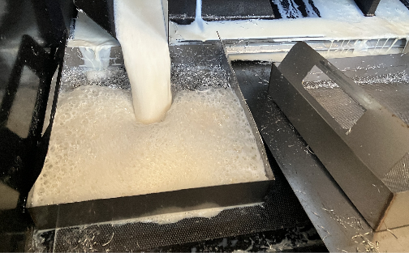
Foam in water-soluble cutting fluids isn’t just about pump pressure or old fluids. It’s the result of a complex mix of variables: fluid properties, maintenance, dilution ratios, system structure, and operator habits. Repeated foaming or frequent tank overflow may even signal degradation or microbial activity.
Checklist when foam appears:
- Is the dilution ratio correct?
- How long has the fluid been in use?
- Is the pump pressure/flow rate appropriate?
- Are there contaminants or sludge in the tank/filter?
- What are the temperature, humidity, and cleanliness levels on-site?
The key is to check regularly and take the issue seriously. Cutting fluid is not just a consumable—it’s a vital indicator of your equipment’s condition.
At DynaSolution, our engineers actively visit production sites to inspect and test water-soluble cutting fluids. We’re dedicated to supporting clean facilities and smooth machining performance. If you’re experiencing foam issues or suspect something’s wrong with your cutting fluid, don’t hesitate to reach out to us.
Dyna Co., Ltd.
Industrial Lubricant Solution
E-Mail : dyna@dynachem.co.kr
Web : dyna.co.kr/en/
 DYNA Co., Ltd