
What is a Radiator?
A radiator is a cooling device installed in front of a car engine. Its primary role is to dissipate the heat generated within the vehicle.
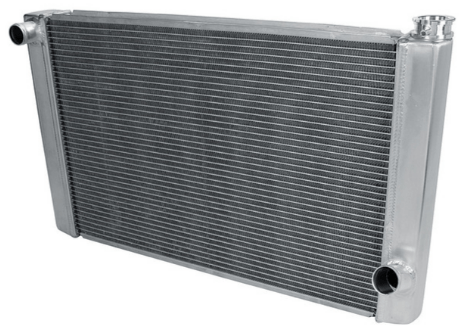
The engine, often referred to as the heart of the car, continuously receives fuel and generates intense heat during combustion. If this heat is left unmanaged, the engine can overheat, causing metal components like the cylinder and piston to melt or become damaged.
To prevent this, a water jacket is installed around the cylinder. Coolant circulates through this jacket to absorb and carry away the heat. However, if the coolant itself becomes too hot, it may begin to boil and lose its cooling capability.
This is where the radiator comes into play—hot coolant is routed to the radiator, where it is cooled before being recirculated.
Since radiators are usually positioned at the front of the vehicle, they are cooled by ambient air flowing in through the grille while driving. A cooling fan is typically located behind the radiator to prevent hot air from stagnating.
Radiators come in different structural types, such as tube-type and cell-type, and are equipped with a thermostat at the outlet of the water jacket to maintain coolant temperature between 75–80°C (167–176°F).
Radiators as Heat Exchangers
Essentially, a radiator functions as a heat exchanger that maintains a stable engine temperature by cooling down hot fluids. Radiators are used not only in cars, but also in aircraft, trains, power generation facilities, and any system that involves engines.
A radiator is mainly composed of:
- Tanks
- Cooling fins
- Tubes
The top section includes the tank, radiator cap, overflow pipe, and inlet pipe.
The core section consists of tubes and densely packed cooling fins.
The bottom section houses the outlet pipe and a drain plug for discharging coolant.
While brass and copper were used in older radiator cores, modern radiators predominantly use aluminum alloys for improved performance.
The radiator cap, once a simple stopper to prevent coolant leakage, is now a pressurized, sealed cap. This pressurization raises the coolant’s boiling point and enhances cooling efficiency by increasing the temperature differential with the outside air.
Radiator Flow Types
Radiators are classified by the direction in which coolant flows:
- Downflow Type
- Tanks are placed on the top and bottom.
- Uses gravity to direct coolant from top to bottom.
- The most common type.
- Crossflow & U-Turn Flow Types
- Tanks are placed on the sides.
- Coolant flows horizontally.
- Offers a larger heat dissipation area for improved heat exchange, but creates higher flow resistance, requiring stronger water pumps.
Press Oil for Radiator Fins
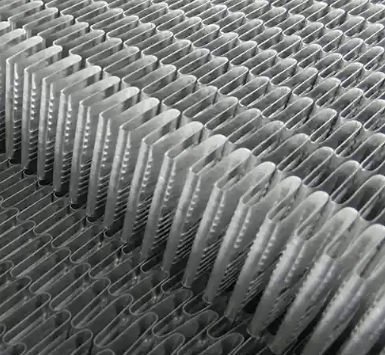
As shown in the illustration, radiators are filled with densely packed aluminum fins. Press oil (punching oil) is used during the pressing process to form these aluminum fins into precise shapes.
In order to press thin aluminum sheets into the required form:
- The pressing machine’s performance is critical,
- But equally important is the quality of the press oil used.
If the press oil’s viscosity or flash point is unsuitable, it may lead to issues in the pressing process, resulting in:
- Poor product shaping,
- The need for additional cleaning steps,
- Or even higher production costs due to cleaning difficulties.
Why Dyna?
At Dyna, we produce press oils that are:
- Odorless, colorless, and safe, made from refined, high-performance base oils.
- Optimized with additives specifically designed for radiator fin pressing.
- Certified with FDA approval, ensuring safety for workers and compliance for global manufacturing standards.
Our radiator press oils have been supplied for over 25 years to major international radiator manufacturers.

Dyna Co., Ltd.
Industrial Lubricant Solution
E-Mail : dyna@dynachem.co.kr
Web : dyna.co.kr/en/
 DYNA Co., Ltd
댓글 남기기