
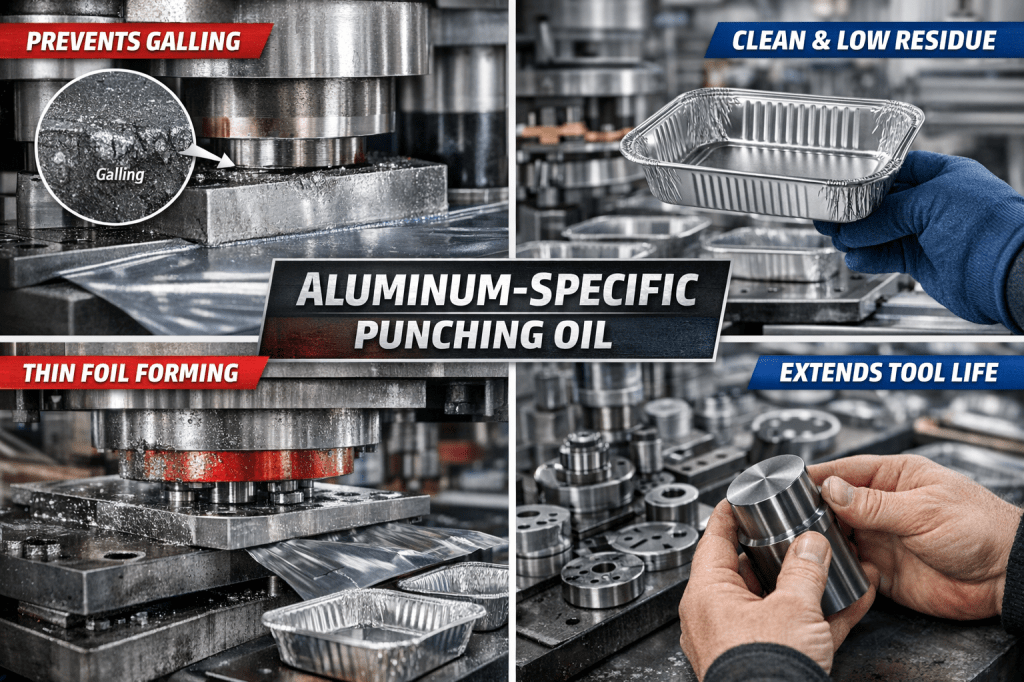
Aluminum is widely used across many industries—including food packaging, automotive, electronics, and home appliances—thanks to its light weight and excellent formability.
However, aluminum behaves very differently from steel during press operations, which makes general-purpose punching oils insufficient for stable and efficient production.
This is why aluminum-specific punching oils are becoming increasingly important.
1. Aluminum Is a “Sticking” Metal
The biggest challenge in aluminum punching and stamping is galling.
- Aluminum is a soft metal
- During press operations, it easily adheres to punch and die surfaces
- This leads to scratches, burr formation, and accelerated tool damage
👉 General-purpose punching oils cannot adequately control this adhesive wear.
Role of Aluminum-Specific Punching Oils
- Special additives that suppress aluminum pickup
- Formation of a protective lubricating film on tool surfaces
- Stable cutting edges and consistent forming quality
2. Different Performance Requirements from General Punching Oils
Punching oils designed for steel often show limitations when applied to aluminum:
- Extreme-pressure additives may react unfavorably with aluminum
- Excessive residue leading to die contamination and frequent cleaning
- Over-lubrication issues when processing thin aluminum foil
Aluminum-Specific Punching Oils Are Different
- Aluminum-friendly lubricant chemistry
- Excellent lubricity even at low viscosity
- Uniform lubrication film on thin and delicate materials
3. Optimized for Thin Materials and High-Speed Operations
Aluminum-specific punching oils are especially suited for:
- Aluminum foil food container forming
- High-speed punching and blanking
- Precision stamping of thin-gauge materials
Key Advantages
- Stable lubrication film even at high stroke rates (SPM)
- Minimal sling-off at high speeds
- Compatible with minimal and semi-dry lubrication systems
4. Cleanliness and Low-Residue Performance
Surface cleanliness is critical in aluminum applications, particularly for:
- Food packaging
- Electronics and appliance components
- Parts requiring downstream washing, coating, or bonding
Benefits of Aluminum-Specific Punching Oils
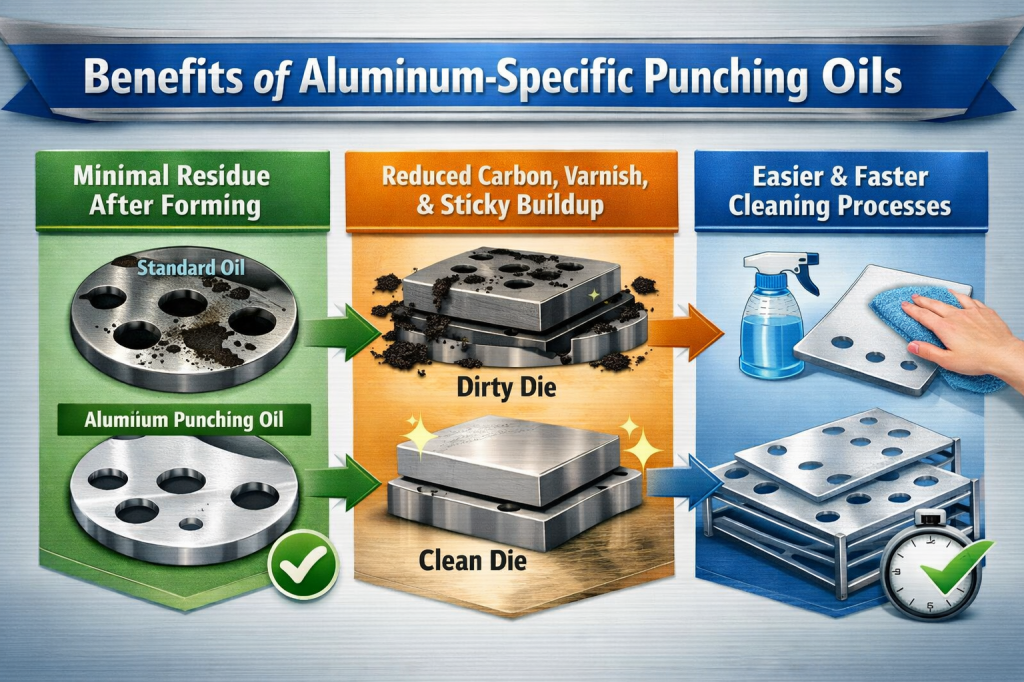
- Minimal residue after forming
- Reduced carbon, varnish, and sticky buildup
- Easier and faster cleaning processes
👉 Result: Less downtime and lower defect rates
5. Direct Impact on Tool Life and Productivity
Using aluminum-specific punching oil results in:
- Reduced punch and die wear
- Extended regrinding intervals
- Fewer tool replacements
Which ultimately leads to:
Lower total production cost and higher operational efficiency
6. Improved Workplace Environment and Safety
Modern manufacturing emphasizes:
- Clean working conditions
- Reduced oil mist and fumes
- Environmental and regulatory compliance
Aluminum-specific punching oils offer:
- Reduced smoke and mist generation
- Cleaner press areas
- Lower waste oil handling requirements
Summary: Why Aluminum-Specific Punching Oils Matter
| Category | General Punching Oil | Aluminum-Specific Punching Oil |
|---|---|---|
| Galling prevention | Fair | Excellent |
| Thin foil performance | Limited | Excellent |
| High-speed stability | Limited | Excellent |
| Cleanliness / residue | Moderate | Excellent |
| Tool life | Average | Extended |
| Minimal lubrication compatibility | Limited | Excellent |
Conclusion
In aluminum press operations, the choice of punching oil directly affects product quality and manufacturing cost.
Aluminum-specific punching oils are not just lubricants—they are process optimization solutions that reduce defects and improve productivity.

Dyna Co., Ltd.
Industrial Lubricant Solution
E-Mail : dyna@dynachem.co.kr
Web : dyna.co.kr/en/
 DYNA Co., Ltd
댓글 남기기