
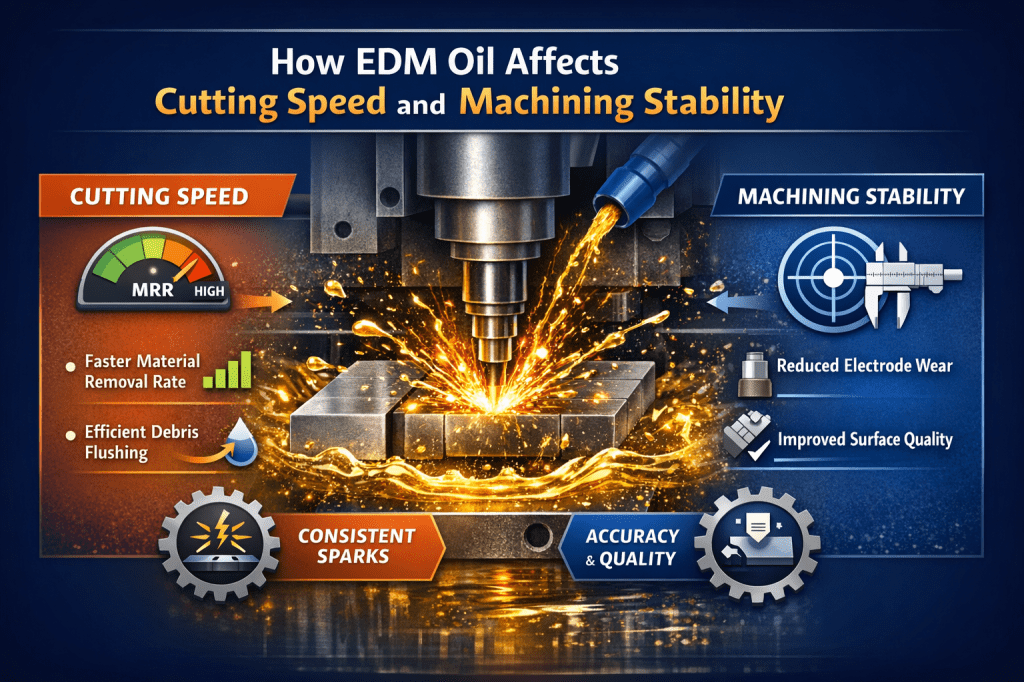
Electrical Discharge Machining (EDM) is a precision process where performance is driven not only by machine settings and electrodes, but also by the quality and characteristics of the EDM oil. Many shops focus on power parameters and tooling, yet overlook how dielectric fluid selection directly impacts cutting speed, machining stability, surface quality, and overall productivity.
This article explains how EDM oil influences cutting speed and machining stability, and what manufacturers should consider when selecting or managing EDM oil.
1. The Role of EDM Oil in the Machining Process
EDM oil serves as a dielectric medium between the electrode and the workpiece. Its primary functions include:
- Electrically insulating the gap until discharge occurs
- Rapidly cooling the machining zone
- Flushing away eroded particles and debris
- Stabilizing spark generation
If the EDM oil fails in any of these roles, machining performance degrades immediately.
2. EDM Oil and Cutting Speed
Dielectric Strength and Spark Efficiency
High-quality EDM oil has stable dielectric strength, allowing sparks to occur consistently at the correct gap voltage. When dielectric strength is optimal:
- Sparks are uniform
- Energy is efficiently transferred
- Material removal rate (MRR) increases
Low-quality or degraded oil causes irregular discharges, reducing effective cutting speed and forcing operators to slow down machining conditions.
Viscosity and Debris Removal
Cutting speed is strongly influenced by flushing efficiency. EDM oil with the proper viscosity:
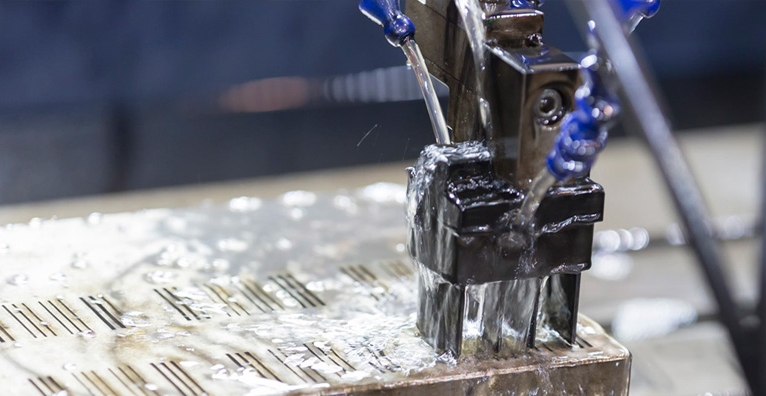
- Removes molten particles quickly
- Prevents re-attachment of debris to the work surface
- Maintains a clean spark gap
Oil that is too thick traps debris, leading to unstable discharges and frequent short circuits—both of which slow machining progress.
Oil Cleanliness and Filtration
Contaminated EDM oil reduces cutting speed by:
- Absorbing discharge energy
- Increasing abnormal arcing
- Causing unstable gap conditions
Well-filtered oil ensures consistent spark energy, enabling higher cutting speeds without sacrificing accuracy.
3. EDM Oil and Machining Stability
Stable Spark Generation
Machining stability depends on maintaining a controlled and repeatable spark cycle. Proper EDM oil:
- Suppresses random arcing
- Reduces short circuits
- Maintains steady gap conditions
Unstable oil conditions lead to frequent machine alarms, electrode damage, and inconsistent results.
Thermal Control and Heat Dissipation
EDM generates intense localized heat. High-performance EDM oil provides:
- Efficient heat removal
- Reduced thermal shock
- Lower risk of micro-cracks and surface defects
Poor thermal control can destabilize machining and degrade part quality, especially during long machining cycles.
Prevention of Carbon Deposits and Sludge
Inferior or oxidized EDM oil can create:
- Carbon buildup on electrodes
- Sticky sludge in the tank
- Erratic discharge behavior
This directly impacts stability, increasing downtime and maintenance frequency.
4. Impact on Electrode Wear and Accuracy
Stable EDM oil not only improves speed but also:
- Reduces electrode wear
- Maintains consistent dimensional accuracy
- Improves repeatability across multiple parts
Unstable oil conditions often result in uneven electrode erosion, forcing tool compensation and rework.
5. Best Practices to Maximize EDM Performance
To optimize cutting speed and machining stability:
- Use EDM oil with high dielectric strength and low viscosity
- Maintain effective filtration and oil cleanliness
- Monitor oil degradation and oxidation
- Replace oil before severe performance loss occurs
- Select oil appropriate for roughing vs. finishing operations
6. Conclusion
EDM oil is not a passive consumable—it is a critical performance driver. The right EDM oil enables:
- Faster cutting speeds
- Stable and predictable machining
- Lower electrode wear
- Improved surface finish
- Reduced downtime and scrap
Investing in high-quality EDM oil and proper oil management is one of the most cost-effective ways to improve EDM productivity and reliability.

Dyna Co., Ltd.
Industrial Lubricant Solution
E-Mail : dyna@dynachem.co.kr
Web : dyna.co.kr/en/
 DYNA Co., Ltd
댓글 남기기