
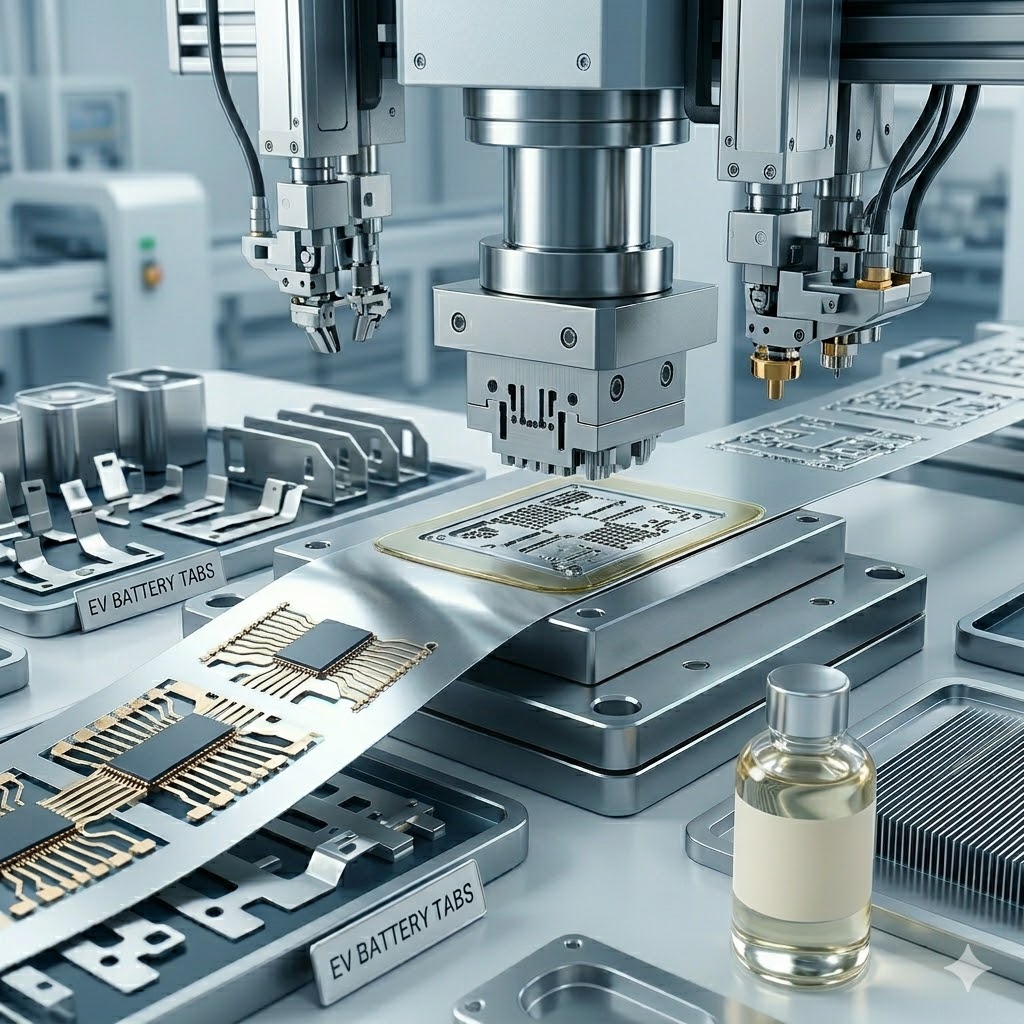
As manufacturing precision continues to reach new heights, Stamping/Punching Oil has evolved beyond a simple consumable. It is now a strategic element that determines both Product Quality and Process Cost.
While oil selection in the past was limited to reducing die friction, in today’s era of ultra-precision machining, it must be viewed as a process partner that dictates quality design and production line economics.
In environments where high-speed stamping occurs thousands of times per minute, selecting the wrong oil can lead to catastrophic risks—generating tens of thousands of defects (scrap) in just a few minutes of error. In short, stamping oil strategy is a critical decision-making factor that directly impacts a company’s manufacturing competitiveness and overall business impact.
1. Electronics, Semiconductors & Secondary Batteries: “The Battleground for Zero-Residue Technology”

In these industries, microscopic residues are an “absolute risk” that cause fatal defects in downstream processes such as plating, assembly, and electrolyte injection. Therefore, achieving Zero-Residue characteristics is the primary principle for ensuring manufacturing reliability.
- Semiconductor Lead Frames: Requires stamping ultra-thin copper alloys (under 0.1mm) thousands of times per minute. High-performance, low-viscosity oils that evaporate quickly after processing while minimizing die wear are essential.
- Secondary Battery Cases: When processing aluminum (anode) and copper (cathode) foils, preventing tears is vital. Controlling ionic cleanliness to prevent internal cell contamination is the key to quality.
- Key Value: Adopting “No-clean, High-volatility Stamping Oils” that eliminate or simplify cleaning processes is synonymous with productivity. This provides an overwhelming advantage in Total Cost of Ownership (TCO) by removing the CAPEX and OPEX associated with operating cleaning lines.
2. Automotive & EV: Optimizing Material Diversification and Mass Production Stability

The transition to Electric Vehicles (EVs) has triggered an increase in non-ferrous metals to reduce vehicle weight. Technical advancement in stamping oils is required to manage the physical loads generated in harsh mass-production environments.
- EV Motors and Structural Components: The proportion of aluminum alloys is rising for lightweighting. Extreme Pressure (EP) stability is crucial to prevent material scratches while managing the heat generated during the processing of high-strength steel sheets.
- Key Value: In the automotive industry, processing stability goes beyond reducing defect rates; it is a business strategy to secure cost competitiveness by protecting expensive die assets and minimizing production downtime.
3. Home Appliances & Electrical Components: Film Control Technology for Maximum Energy Efficiency

In the appliance sector, micro-film control technology—which directly relates to energy efficiency ratings—is the new benchmark for competitiveness.
- Motor Cores (Electrical Steel): In the lamination process where hundreds of steel sheets are stacked, inconsistent or thick oil films cause stacking errors (reduced Stacking Factor). This leads to Magnetic Flux Leakage during motor operation, increasing energy loss. Applying “Ultra-thin Film Control Technology” to improve lamination precision is a core technical factor in upgrading a motor’s Efficiency Class.
- Air Conditioner Fins: Preventing die contamination and ensuring fast volatility during high-volume aluminum processing are direct drivers for maximizing productivity per unit of time by increasing Strokes Per Minute (SPM).
- Key Value: Residue minimization technology allows for the perfect realization of physical design specifications, simultaneously achieving quality standardization and energy competitiveness.
4. Aerospace: High-Difficulty Machining Solutions for Extreme Reliability

The aerospace industry combines the difficulty of processing high-value materials (Titanium, Inconel) with the absolute value of aviation safety. Here, even a 0.1% machining error or a microscopic surface defect is unacceptable.
- Engines and Propulsion Systems: Heat-resistant superalloys like Titanium and Inconel cause extreme die wear. High-performance Extreme Pressure (EP) formulation technology is a critical variable that determines success.
- Airframe Structures (7075 Aluminum): When punching tens of thousands of rivet holes, the Surface Finish is directly linked to the aircraft’s Fatigue Life. Micro-scratches act as Stress Risers, which can cause structural cracks over time. The role of stamping oil in suppressing heat and forming smooth cross-sections is essentially the foundation of aviation safety.
- Key Value: Adopting solutions that prevent material transformation and maintain superior surface quality is a mandatory choice to guarantee aerospace safety.
Is Your Stamping Process Optimized?
Most problems occurring in the stamping process stem from selecting oils without considering “industry-specific characteristics.”
Dyna Solution provides more than just oil; we provide customized lubrication solutions optimized for your specific materials and equipment environment.
If you are considering the introduction of stamping oils for 0.1mm ultra-thin processing or precision machining, we invite you to experience the advanced technological prowess of Dyna Solution firsthand.
Dyna Co., Ltd.
Industrial Lubricant Solution
E-Mail : dyna@dynachem.co.kr
Web : dyna.co.kr/en/

 DYNA Co., Ltd
댓글 남기기