
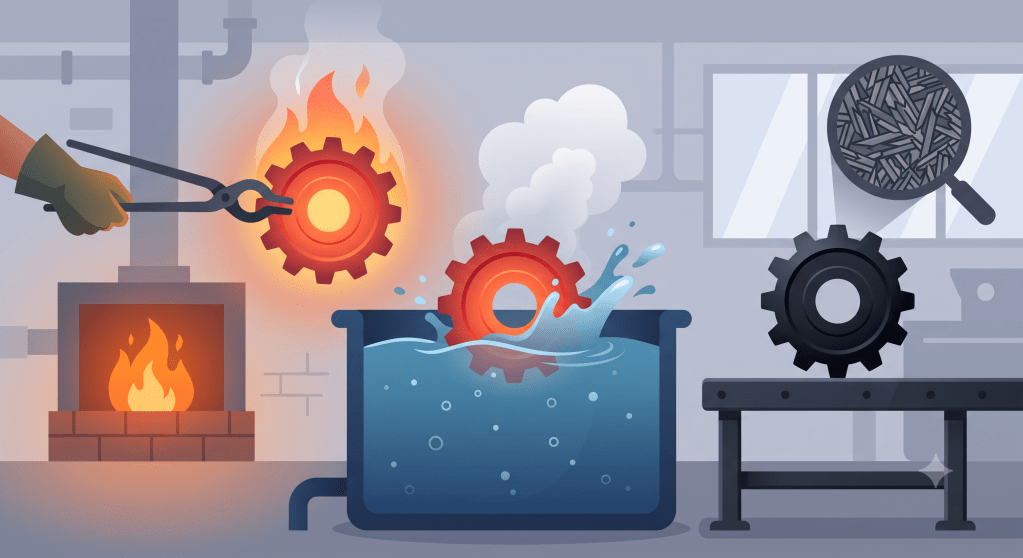
In the heat treatment process, which determines the strength and lifespan of metal, the most dramatic moment is undoubtedly “Quenching.” This process, in which red-hot metal is plunged into a liquid to cool it down in an instant, is called the flower of metalworking.
However, this raises a question: “Why can’t we just cool it with common water from around us? Why do we have to use expensive special oil (quenching oil)?”
Today, we will dive into the clear reasons why the heat treatment field has no choice but to insist on special oil instead of water.
1. Quenching: Why Do It?
To understand the reason, we must first understand the purpose of quenching. The core of quenching is to make the metal extremely hard.
When steel is heated to a high temperature of over 800–900°C and then rapidly cooled, the internal structure of the metal changes into a very hard and dense structure called “Martensite.” In other words, a “rapid temperature change” is the magic spell that makes steel strong.
2. The Disaster That Happens When Cooling with Water
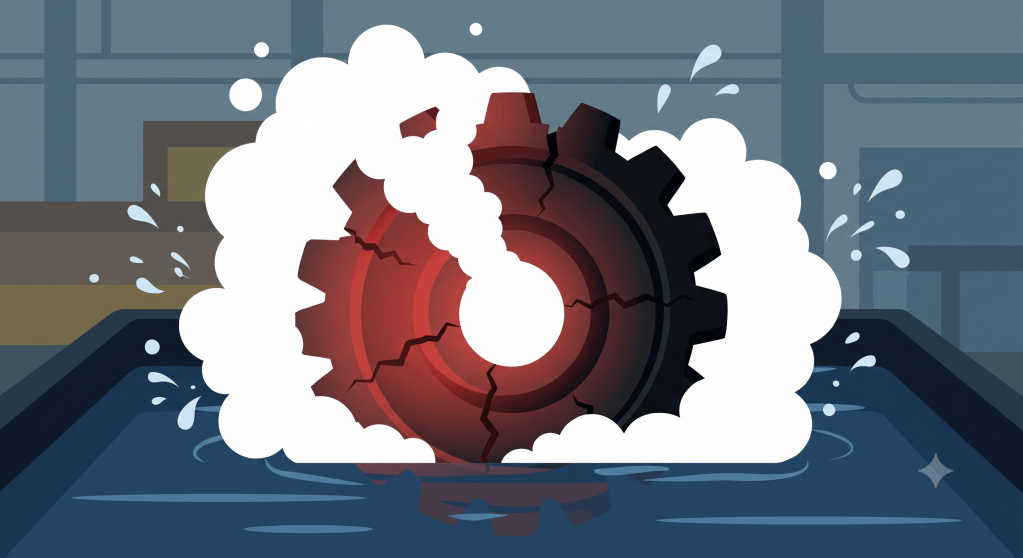
Water is the most readily available substance on Earth and has an enormously fast cooling rate. However, in industrial fields dealing with precision parts, this “too-fast cooling” becomes a fatal poison.
- Fatal Deformation and Cracks: When the temperature drops too rapidly, the contraction rates of the inside and outside of the metal differ, generating tremendous stress (residual stress). As a result, components carefully machined can twist or, worse, crack like broken glass.
- Uneven Cooling: When hot metal touches water, it boils instantly, and a vapor blanket covers the surface of the metal. Parts covered by vapor cool slowly, while parts touched by water cool quickly, ultimately making the hardness uneven across different sections of the part.
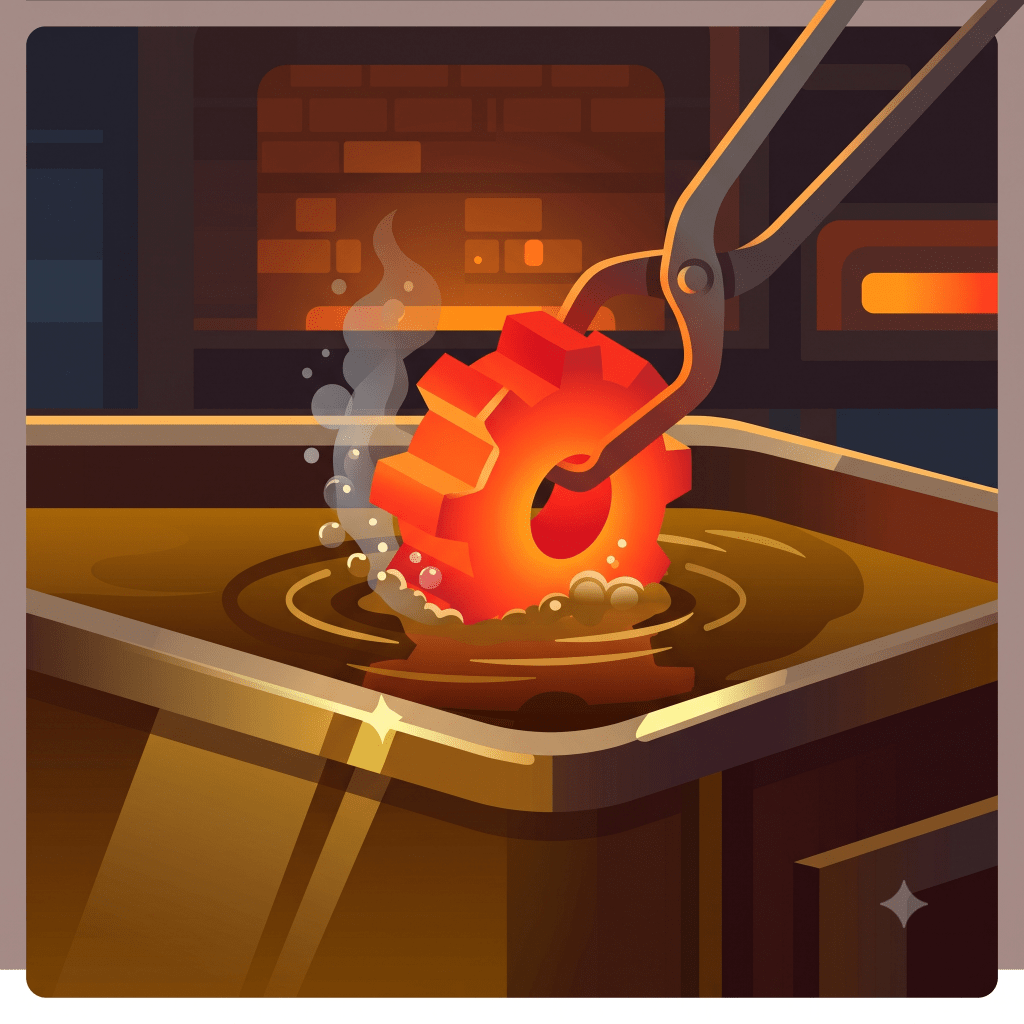
3. Three Reasons Why Special Oil (Quenching Oil) Works Like Magic
Quenching oil is a scientifically engineered liquid designed to completely control these fatal disadvantages of water.
Using oil instead of water provides the following decisive advantages:
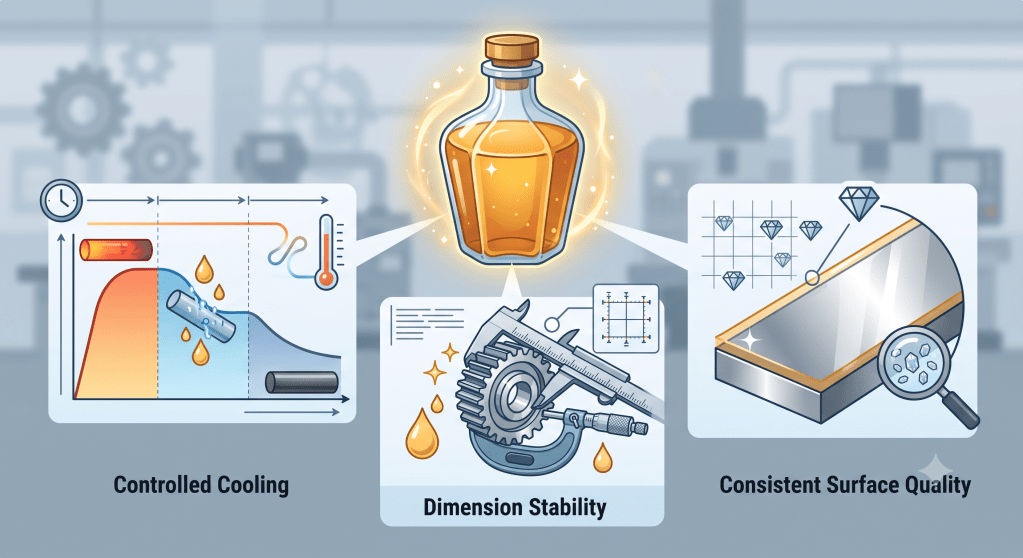
① Customized Cooling Rate Control (Cooling Gently)
Quenching oil smartly adjusts the cooling rate so that the metal achieves its ideal hardness. It cools slowly in the initial stage, quickly in the middle, and slowly again at the end, gently coaxing the metal so it does not suffer “thermal shock.”
② Perfect Dimensional Stability (Minimizing Deformation)
Thanks to smooth and uniform cooling, internal stress within the metal is minimized. It is the primary contributor to preventing dimensional deformation in parts where even an error of 0.01 mm is unacceptable, such as precision automotive gears or aerospace components.
③ Consistent Surface Quality Maintenance
Even if a vapor blanket forms, oil breaks it down much faster and more uniformly than water. As a result, the entire part cools evenly to achieve consistent hardness, while preventing oxidation or corrosion during the cooling process to keep the surface quality neat.
Summary
If water simply plays the role of “lowering the temperature” of the metal, special quenching oil acts as a custom designer that “maximizes the metal’s strength while maintaining its shape perfectly.”
Ultimately, choosing a good quenching oil becomes a core competitive advantage for a company, reducing defect rates and determining product lifespan.
Dyna Solution Co., Ltd.
Industrial Lubricant Solution
E-Mail : dyna@dynachem.co.kr
Web : dyna.co.kr/en/
 DYNA SOLUTION Co., Ltd
댓글 남기기