
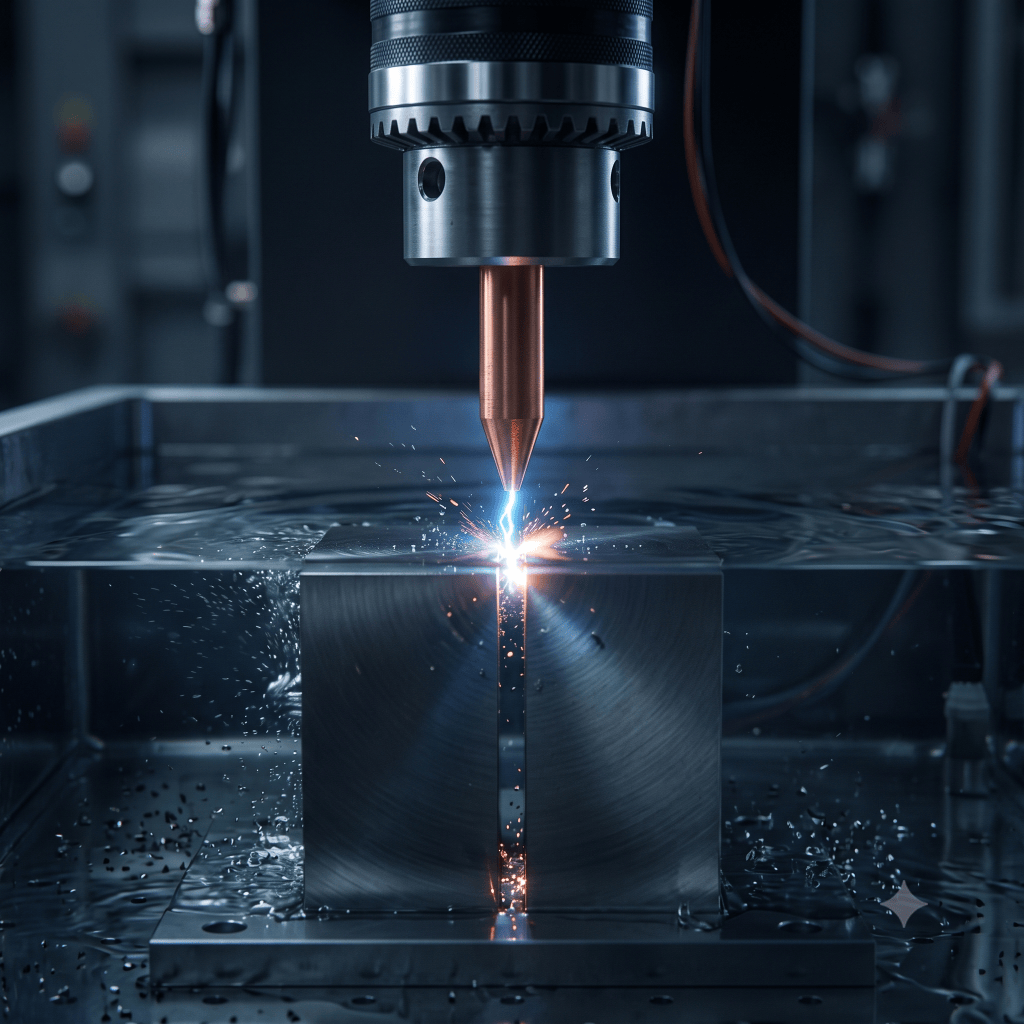
“Carving hard metals with lightning sparks instead of physical cutting blades?”
Electrical Discharge Machining (EDM) is a fascinating, high-precision manufacturing method that uses thermal energy from electrical discharges rather than conventional mechanical cutting tools. From aerospace components and precision molds to medical devices, EDM is essential for processing hard-to-machine materials that cannot easily be cut using standard milling operations.
For this spark-erosion process to function properly, three core components must interact with absolute precision: the electrode, the dielectric fluid, and the power supply.
1. The Sculptor Shaping the Part: The Electrode
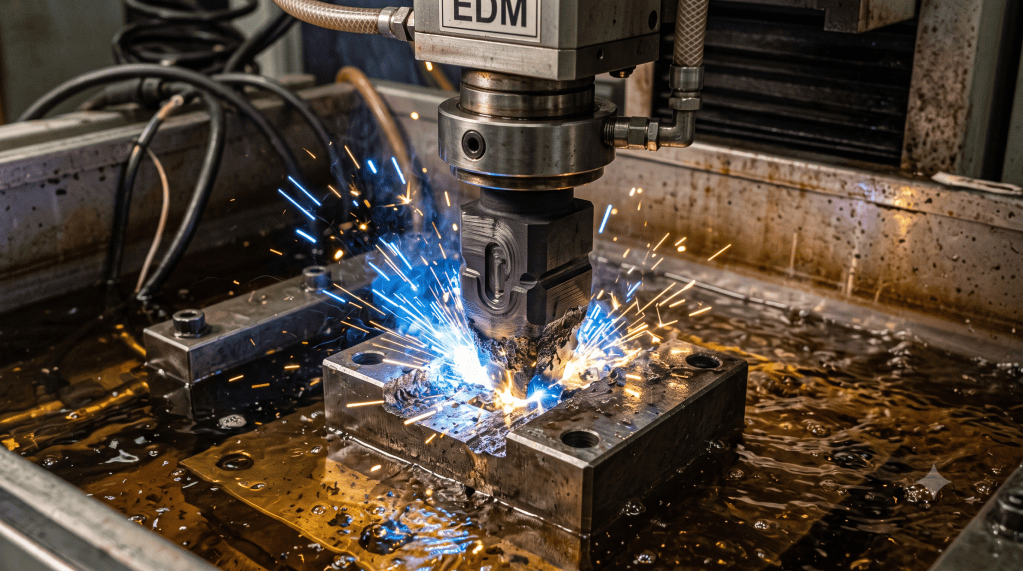
In conventional machining, the electrode corresponds to a cutting tool like a drill or an end mill. However, it never physically contacts the workpiece. Instead, it maintains a microscopic spark gap across which it discharges electrical energy to melt and vaporize the metal.
- Primary Materials: Electrodes must exhibit both high electrical conductivity and superior thermal resistance. Copper and graphite are standard choices for sinker EDM, while brass wire is typically used in wire EDM.
- Role: The geometry of the electrode directly dictates the shape of the finished cavity. For instance, if an electrode is machined into a star shape, it produces an identical star-shaped impression in a hardened steel block.
2. The Unseen Support: Dielectric Fluid
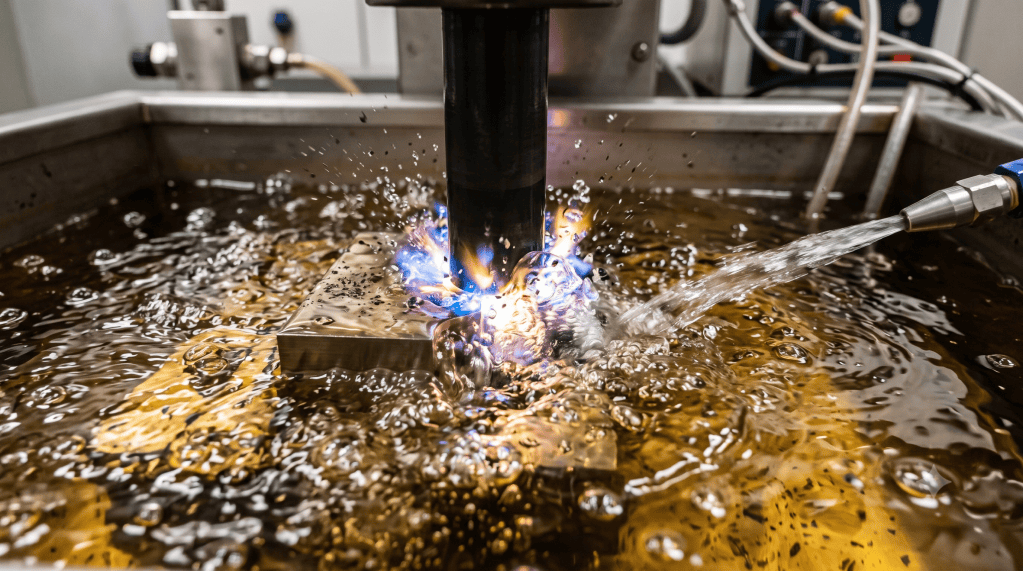
Precision machining would be impossible if sparks were allowed to jump erratically in open air. For this reason, EDM is conducted with the cutting zone fully submerged in or flushed by a specialized dielectric fluid.
- Types: Sinker EDM (die-sinking) predominantly uses specialized hydrocarbon-based EDM oils, whereas Wire EDM typically uses deionized (DI) water.
- The 3 Core Functions:
- Insulation: It acts as an electrical barrier until peak dielectric breakdown voltage is reached, concentrating high-energy sparks precisely across the narrow gap.
- Cooling: It dissipates the intense thermal energy—which can exceed several thousand degrees Celsius—protecting both the electrode and the workpiece from thermal distortion and burning.
- Flushing: It clears away eroded microscopic metal particles (swarf/chips) from the gap, preventing short circuits and accumulation.
3. The Brain Directing the Sparks: The Power Supply (Generator)
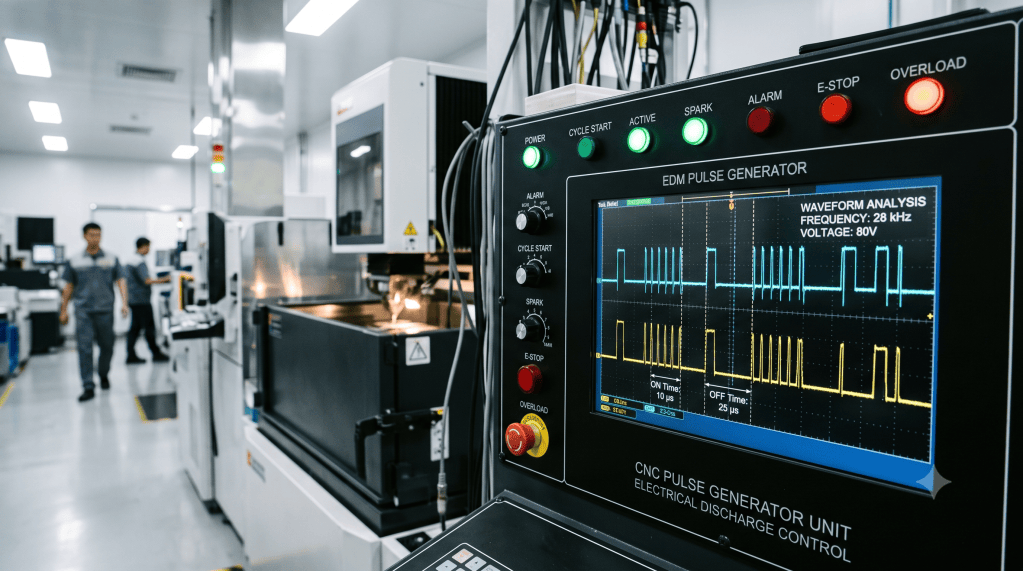
Having the electrode and fluid in place is not enough; you cannot simply plug the system into a standard electrical outlet. The essence of EDM lies in pulsing the electric current on and off thousands to tens of thousands of times per second. The power supply generator governs this cycle.
- Role: It controls voltage, peak amperage, and the pulse duration (On-time and Off-time) down to microsecond intervals.
- Determining Machining Quality:
- High Current + Longer Pulse Duration: Delivers faster material removal rates (roughing), but results in a rougher surface finish.
- Low Current + Shorter Pulse Duration: Yields slower material removal (finishing), producing high-precision, mirror-like surface finishes.
In Summary
EDM is a thermal ablation process where the electrode acts as the sculpting tool, carving away metal via electrical sparks driven by the power supply. Throughout this intense, high-heat process, the dielectric fluid maintains thermal stability, insulation, and flushing. If any one of these three elements fails, reliable precision EDM cannot occur.
💡 Need the Right Dielectric Fluid for Precision Machining?
The quality of your dielectric fluid directly influences machining accuracy, surface roughness ($R_a$), and machine component lifespan. For high-performance EDM fluids and tailored industrial lubricant solutions, reach out to Dyna Solution anytime. We provide comprehensive technical support and tailored product recommendations.

Dyna Solution Co., Ltd.
Industrial Lubricant Solution
E-Mail : dyna@dynachem.co.kr
Web : dyna.co.kr/en/


댓글 남기기