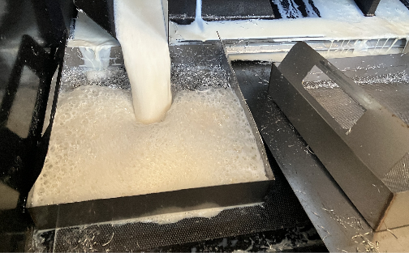
Water-soluble quenching oils can be classified into two types based on whether they form a film on the surface of the quenched part during the cooling process:
- Non-Film Forming Type: Does not create a film on the surface during quenching.
- Film Forming Type: Creates a thin film at lower cooling temperatures (below 300°C).
1. Non-Film Forming Aqueous Solutions
(1) Acidic Solutions
Inorganic acid solutions, such as sulfuric acid and hydrochloric acid, show varying cooling characteristics depending on concentration and temperature.
- For example, a 10% hydrochloric acid solution at 20°C has an H-value of 4.5 in the high-temperature range and 0.2 in the low-temperature range.
- Organic acids such as acetic acid (20%, 20°C) show H-values of 1.5 (high-temp) and 0.35 (low-temp).
(2) Alkaline Solutions
Sodium hydroxide (NaOH) and potassium hydroxide (KOH) are commonly used.
- A 5% NaOH solution at 20°C shows H-values of 10.5 (high-temp) and 0.8 (low-temp).
(3) Salt Solutions (Brine)
Common salts include NaCl and CaCl₂.
- A 10% NaCl solution at 20°C has H-values of 9.0 (high-temp) and 0.65 (low-temp).
- These salt solutions have higher cooling performance than water due to elevated boiling points caused by dissolved salts, which delay vapor formation.
(4) Emulsion-Type Solutions
This includes solutions of soap and water-soluble oils.
- A 0.05% soap solution at 20°C has an H-value of 0.05 at high temps, which increases around 400°C and then drops to 0.65 at lower temps.

(5) Glycol-Based Solutions
These include both polymers and monomers.
- Polyalkylene Glycol (PAG): Also known as polyethylene glycol ether, it has been used industrially since the early 1960s. Special synthesis and blending techniques provide long-term thermal stability and corrosion resistance.
- Polyethylene Glycol (PEG): Obtained by polymerizing ethylene oxide. Due to technical limitations, it hasn’t been widely applied.
- Ethylene Glycol: A colorless liquid with a sweet taste that absorbs moisture and is miscible with water, ethanol, and acetic acid. Upon oxidation, it forms glycolic acid, glyoxal, and oxalic acid. It’s widely used in Tetron production, alkyd resins, antifreeze, pharmaceuticals, and cosmetics.
- Glycerin: Used as a laxative, lubricant, and moisturizer. In combination with other drugs, it’s used in creams, eye drops, and injections for treating frostbite, dry eyes, or for volume reduction during surgery.
2. Film Forming Aqueous Solutions
When using film-forming aqueous solutions for spray cooling, solutes typically decompose or burn at high temperatures and do not adhere to the part’s surface, resulting in cooling performance similar to water.
However, at lower temperatures, the solutes form a film on the surface, slowing the cooling rate.
Typical film-forming solutes include natural substances (e.g., gum arabic, albumin, gelatin, agar, starch) and synthetic polymers (e.g., polyvinyl alcohol [PVA], carboxymethyl cellulose [CMC]).
Characteristics of Water-Soluble Quenching Media
- No fire hazard.
- Enables use of lower-cost steels.
- Environmentally friendly and easy to dispose of.
To fully utilize these advantages, the following performance characteristics are required:
- Ability to achieve desired cooling performance based on concentration and temperature.
- Ease of managing cooling performance.
- Minimal quality change due to degradation.
- Resistance to spoilage.
- Ease of wastewater treatment.
Meeting these conditions allows for broader adoption of water-based quenching over oil-based methods, expanding steel selection options.
3. Precautions When Using Water-Soluble Quenching Oils
- Uniform Cooling: Ensure even and simultaneous cooling across the part to avoid quenching cracks, particularly in the low-temperature range.
- Safety: Acidic and alkaline solutions can be hazardous. While salt solutions pose less risk, attention should still be paid to the specific solute. Glycol-based solutions (non-film-forming) may have odors but are generally safer. Synthetic film-forming solutions offer good stability, while natural solutions tend to spoil and produce odors.
- Cooling Management: Cooling performance is greatly affected by solution concentration, fluid concentration, and contact velocity. It’s advisable to keep the cooling liquid temperature below 40°C.
4. Selecting Quenching Oils
Quenching oil must be selected based on various factors:
- Type of steel and its shape, size, required hardness, metal structure, and expected deformation.
- Quenching method: conventional, atmospheric, salt bath, induction, flame, etc.
- Heating method: gas, electric, kerosene, diesel.
- Furnace type: batch, pit, continuous.
- Carburizing method: gas, liquid, solid.
- Steel grade, dimensions, and tempering temperature.
- Oil tank specs: capacity, agitator type and speed, cooling system size.
- Currently used quenching media and any issues with it.
Proper evaluation of these factors is essential for choosing the appropriate heat treatment oil.

Dyna Co., Ltd.
Industrial Lubricant Solution
E-Mail : dyna@dynachem.co.kr
Web : dyna.co.kr/en/