
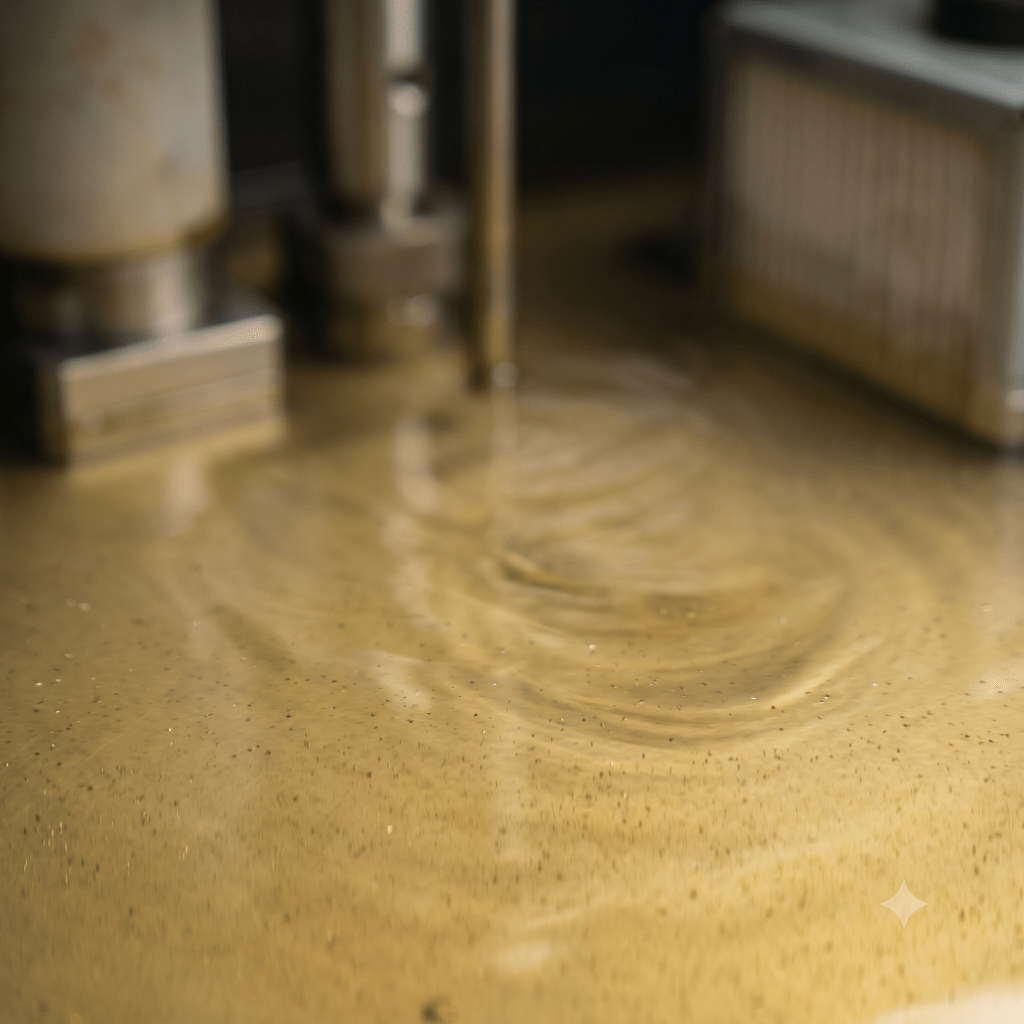
In cost-reduction meetings at mold machining factories, one of the very first targets is often “consumables.” Among these, oils purchased by the drum seem to offer noticeable cost savings even with just a slight drop in the price per liter.
Because of this, many workplaces often opt for cheaper products under the assumption that “all EDM fluids are pretty much the same.” However, lurking behind those low price tags are terrifying “hidden costs” that eat away at the factory’s overall productivity. Today, we will uncover exactly how cheap EDM fluid betrays us on the shop floor and explore the three critical reasons behind it.
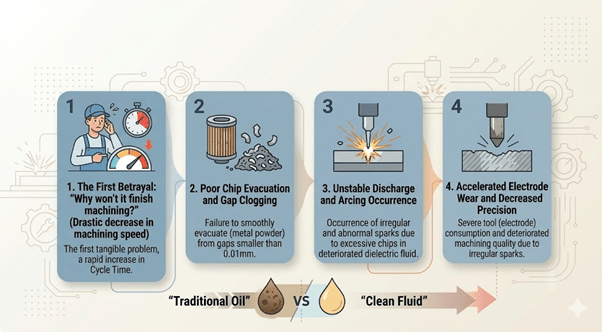
1. The First Betrayal: “Why is the machining taking so long?” (A Sharp Drop in Machining Speed)
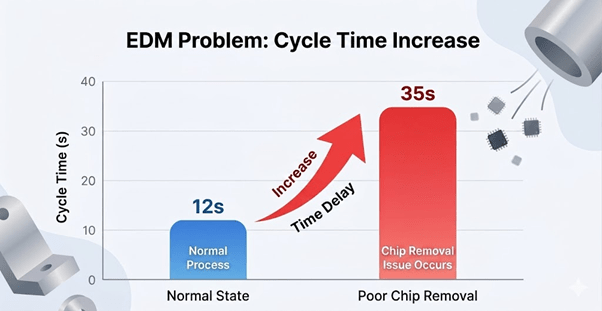
The increase in cycle time is the most immediately noticeable problem. Electrical Discharge Machining (EDM) is a precise process where continuous chip (metal dust) removal from gaps smaller than 0.01mm is required. Low-cost oils cause specific issues, including:
- Poor flushing: The oil cannot maintain stable viscosity or penetration is low, resulting in chips remaining in the machining area.
- Machine idling (jumping): When chips cannot escape, the discharge gap becomes unstable, causing the machine to repeatedly stop sparking and lift the electrode (a ‘Jumping’ motion).
In the end, the machine’s speed fails to reach 100% as hesitation time increases. Although a small amount might be saved on cheap oil, machining time increases by 20–30%, leading to the wasting of high depreciation costs of expensive EDM machines and operator labor costs.
2. The Second Betrayal: “Penny-Wise, Pound-Foolish” (Shortened Consumable Replacement Cycles)
Cheap EDM oils often rely on low-quality base oils or lack essential additives, which significantly degrades their “settling ability”—the capacity to allow sludge and debris to sink to the bottom. This triggers the following chain reaction of financial losses:
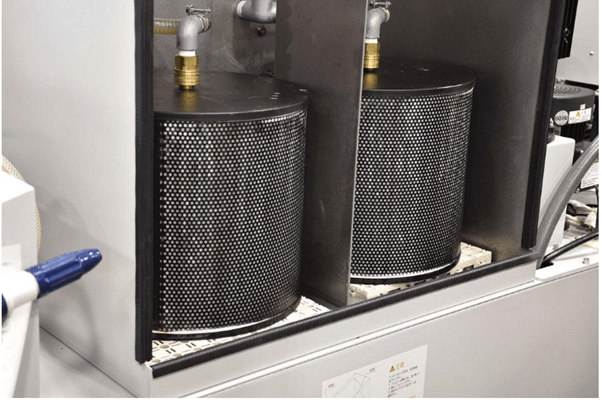
· Filter Clogging: Fine chips floating in the fluid rapidly clog the machine’s filter. If a filter meant to last six months has to be replaced every two to three months, whatever money you saved on the oil is entirely wiped out by the cost of new filters.
· Increased Electrode Wear: If a spark occurs while chips are still trapped in the gap, secondary discharges strike in unintended areas. This unevenly eats away at copper or graphite electrodes—which can cost hundreds of thousands to millions of won—effectively cutting their lifespan in half.
3. The Third Betrayal: “We have to cut it all over again!” (Quality Defects and Rework)
In mold machining, the most agonizing loss is a “defect.” Low-quality EDM fluids have inconsistent dielectric (insulating) properties, meaning that sparks fail to ignite precisely at the intended time and location.
- Poor Surface Finish (Pitting): Pockmarks (pitting) appear on mold surfaces that are supposed to be as smooth as a mirror.
- Dimensional Errors: In precision-critical molds, minute dimensional deviations occur, leading to situations where components fail to assemble.
Ultimately, this adds a tremendous amount of extra time to the polishing (finishing) process, or in the worst-case scenario, leads to a catastrophic disaster where expensive mold materials must be scrapped and re-machined entirely from scratch.
Conclusion: EDM Fluid is About ‘Productivity,’ Not ‘Cost’
Looking strictly at the immediate price per liter, cheap oil may seem attractive. However, when you calculate the Total Cost of Ownership (TCO)—which includes increased machining time, the cost of filter and electrode replacements, and rework expenses—low-end oil is never the cheaper choice.
A proper EDM fluid must meet the following conditions:
- Water-like, ultra-low viscosity to instantly flush out chips.
- A safe, high flash point to prevent fire hazards.
- Excellent settling properties that quickly sink debris to extend filter life.
No matter how much you optimize your EDM machine settings, if efficiency does not improve, you must immediately question the quality of the oil in your equipment. True cost savings in a factory begin with finishing machining ‘the fastest, without defects,’ by using the highest quality fluid.

Dyna Solution Co., Ltd.
Industrial Lubricant Solution
E-Mail : dyna@dynachem.co.kr
Web : dyna.co.kr/en/


답글 남기기