
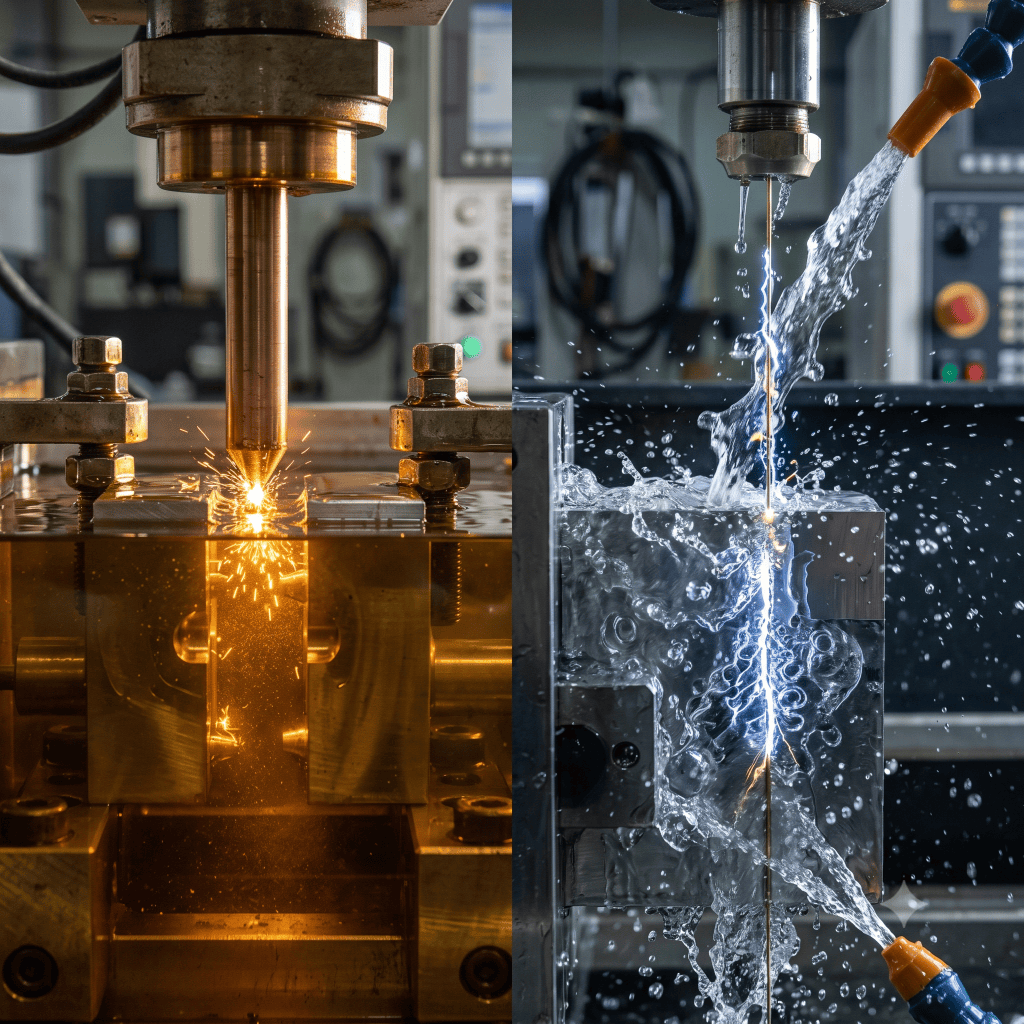
Sinker EDM machines run in oil, while wire EDM machines run in deionized water. Both use the same process, so why do they need different fluids?
Both machines remove metal with electrical sparks between an electrode and the workpiece. The principle is the same, but the machining method, spark energy, gap size and debris flushing are not. That is why each method needs its own dielectric fluid. This post covers the differences between the two fluids and practical tips for managing them.
What the Dielectric Fluid Does
The fluid is more than a coolant. It directly affects spark quality and machining speed.
- Insulation: It insulates the gap between the electrode and the workpiece. When voltage is applied, the insulation breaks down at a single point, which concentrates the spark.
- Cooling: It cools the spark zone, which reaches thousands of °C, and prevents distortion of the electrode and workpiece.
- Flushing: It carries tiny metal particles (debris) out of the gap. Built-up debris causes arcing and rough surfaces.
- Deionization: After each spark, it quickly returns to an insulating state, ready for the next discharge.
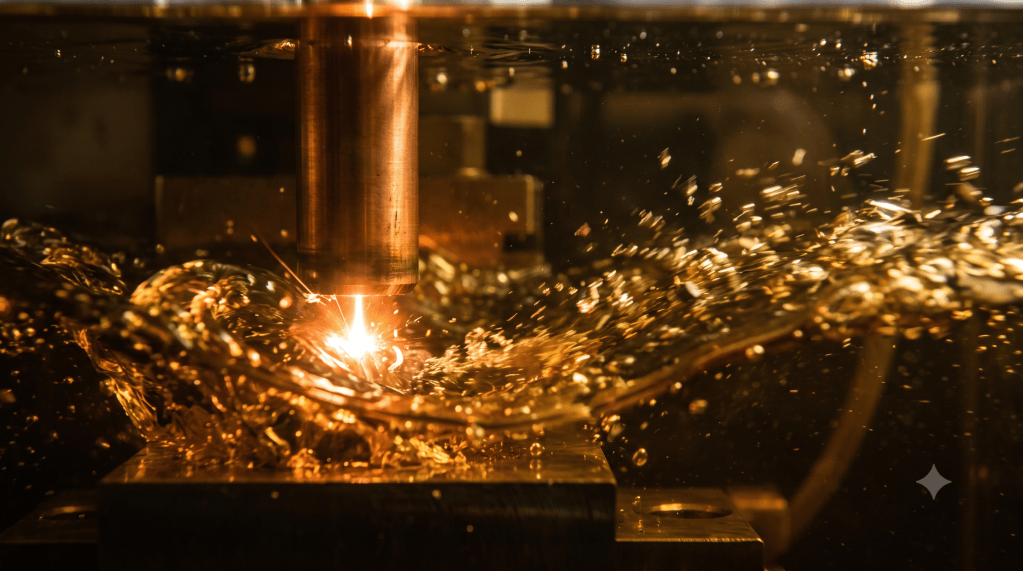
Which of these roles matters most decides whether oil or deionized water is the better choice.
Sinker EDM: Why Oil?
Sinker EDM feeds a shaped electrode (usually copper or graphite) into the workpiece and copies its shape. It is mainly used for deep ribs, square pockets and fine textures in molds.
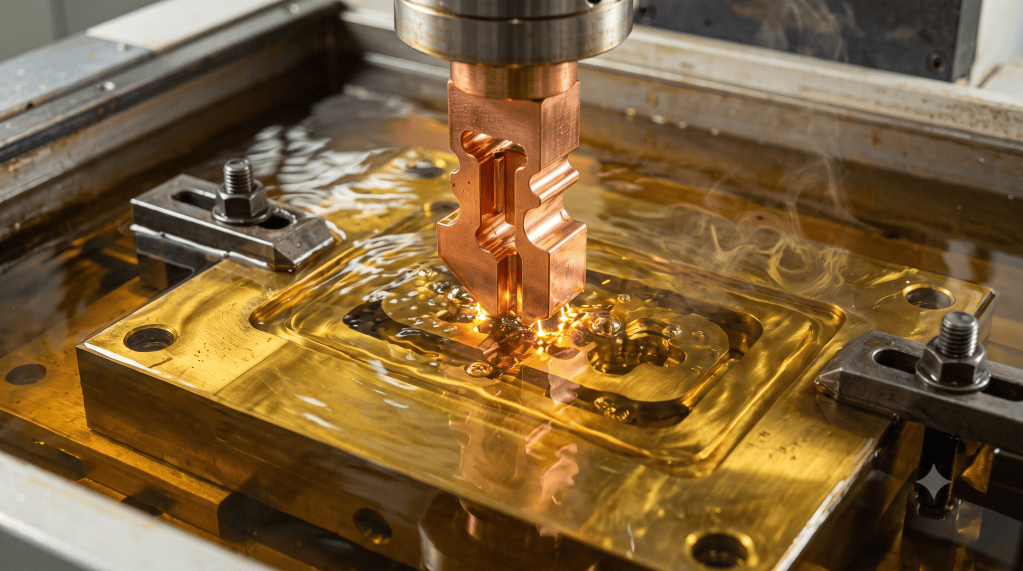
EDM oil suits this method for the following reasons.
- High dielectric strength: A narrow gap can be held, so the shape is copied with high precision.
- Lower electrode wear: As the oil breaks down, carbon deposits on the electrode surface and protects it. This matters in sinker EDM, where the electrode shape must be copied exactly.
- No rust: Neither the workpiece nor the machine rusts, which is ideal for long unattended runs.
- Stable finish: Spark energy spreads evenly, making near-mirror surface finishes easier to reach.
When choosing an oil, check viscosity (lower flows better into fine gaps and suits finishing), flash point (higher is safer against fire) and aromatic content (lower means less odor and skin irritation).
Wire EDM: Why Deionized Water?
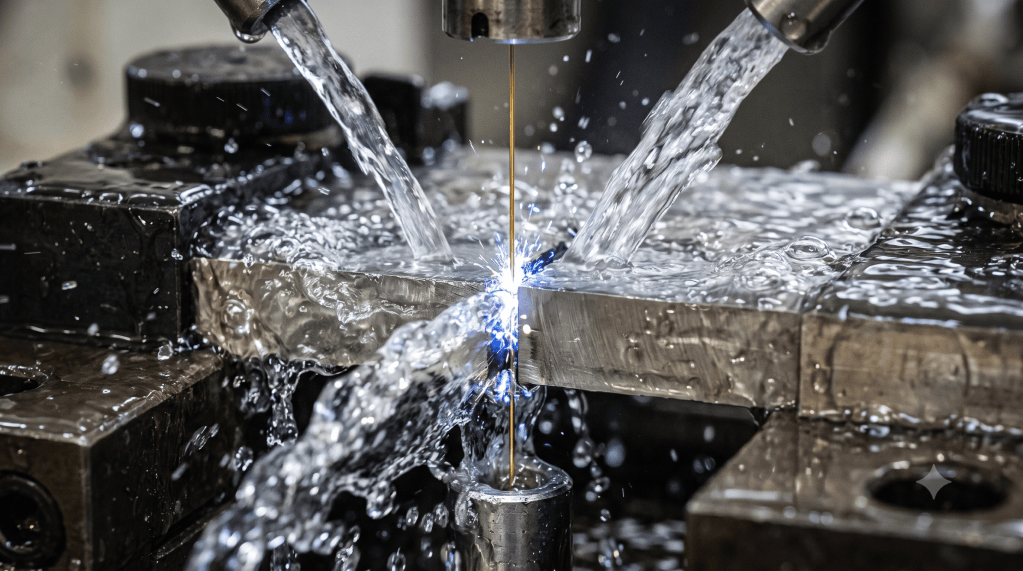
Wire EDM continuously feeds a brass wire about 0.1–0.3 mm in diameter and cuts the workpiece like a thread. It is mainly used for punches, dies and precision contour cutting.
Deionized water (water with its ions removed so it conducts little electricity) suits this method.
- Excellent cooling: Water has higher specific heat and thermal conductivity than oil, which keeps the thin wire from breaking under heat.
- Faster cutting: Low viscosity flushes debris well from narrow slots and supports stable high-energy sparks.
- No fire risk: It is well suited to unattended overnight machining.
- Electrode wear is not an issue: Fresh wire is fed continuously, so the electrode protection that oil provides is not needed.
Water does pick up ions again over time, which raises its conductivity. Resistivity (or conductivity) must be kept steady with ion-exchange resin. Note that some wire EDM machines built for ultra-precision or high-quality finishes do use oil.
At a Glance
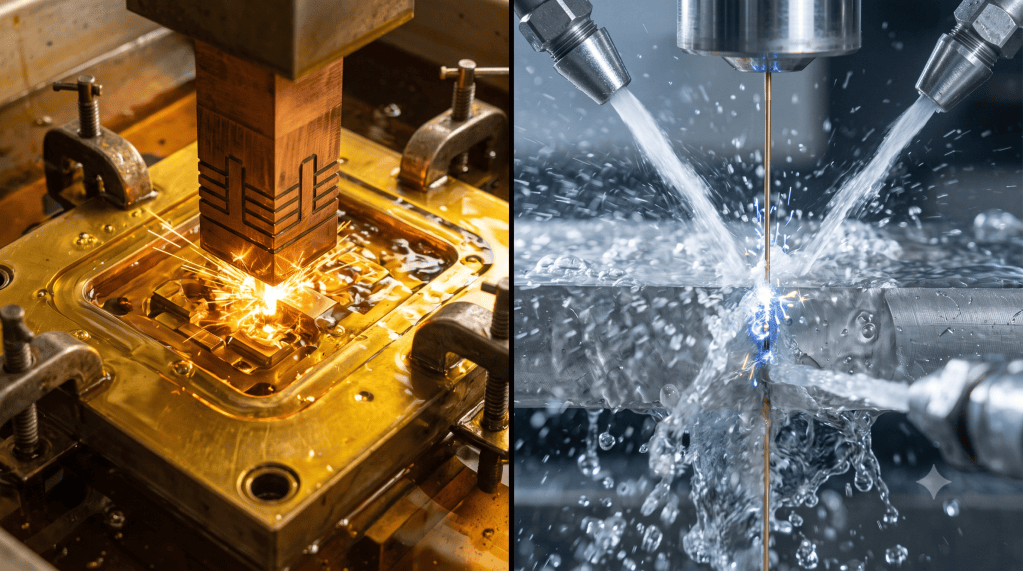
| Item | Sinker EDM + EDM oil | Wire EDM + deionized water |
|---|---|---|
| Main use | Mold ribs, pockets, textures | Punches, dies, contour cutting |
| Dielectric strength | Very high | Low (resistivity must be controlled) |
| Cooling | Moderate | Very high |
| Electrode wear | Low (carbon protective layer) | Not relevant (wire fed continuously) |
| Rust | None | Possible (rust prevention needed) |
| Fire risk | Yes (manage fluid level and flash point) | None |
| Key maintenance items | Filters, degradation, fluid level, ventilation | Resistivity, resin, water temperature |
| What gets replaced | The oil itself | Ion-exchange resin, filters |
Shop-Floor Maintenance Tips
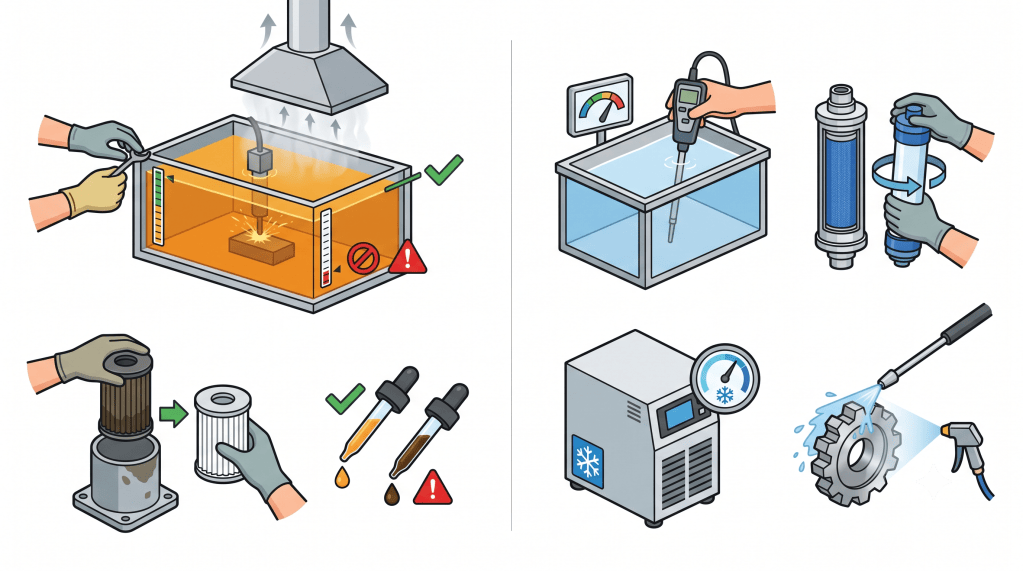
Managing EDM oil (sinker EDM)
- Keep the fluid level well above the machining point. Sparking near the surface raises the fire risk.
- Replace filters on time to remove debris and carbon.
- Suspect degraded oil if it darkens, smells stronger or machining slows down.
- Use local exhaust and ventilation to reduce operators’ exposure to oil mist.
Managing deionized water (wire EDM)
- Keep resistivity within the machine maker’s recommended range. Outside it, wire breaks and surface defects increase.
- If resistivity will not recover, it is time to replace the ion-exchange resin.
- Keep the water temperature steady for consistent dimensional accuracy.
- Clean and rust-proof workpieces right after machining.
FAQ
Q. Can I use water in a sinker EDM machine?
It is possible but uncommon. Electrode wear increases, rust forms and shape accuracy drops.
Q. Can I use kerosene or cutting oil instead of EDM oil?
We do not recommend it. A lower flash point or different additives raise the fire risk, cause more odor and skin irritation, and make machining quality unstable.
Q. Can I add tap water directly to a wire EDM machine?
You can top up with it, but it must pass through the ion-exchange resin and reach the right resistivity before machining.
Conclusion
In short, sinker EDM copies a shape, so insulation and electrode protection matter most, and it uses oil. Wire EDM cuts with a thin wire, so cooling and speed matter most, and it uses deionized water. Either way, the condition of the fluid drives machining speed, surface finish and safety.
If you need help choosing the right EDM oil for your machine and application, feel free to contact us.

Dyna Solution Co., Ltd.
Industrial Lubricant Solution
E-Mail : dyna@dynachem.co.kr
Web : dyna.co.kr/en/


답글 남기기