
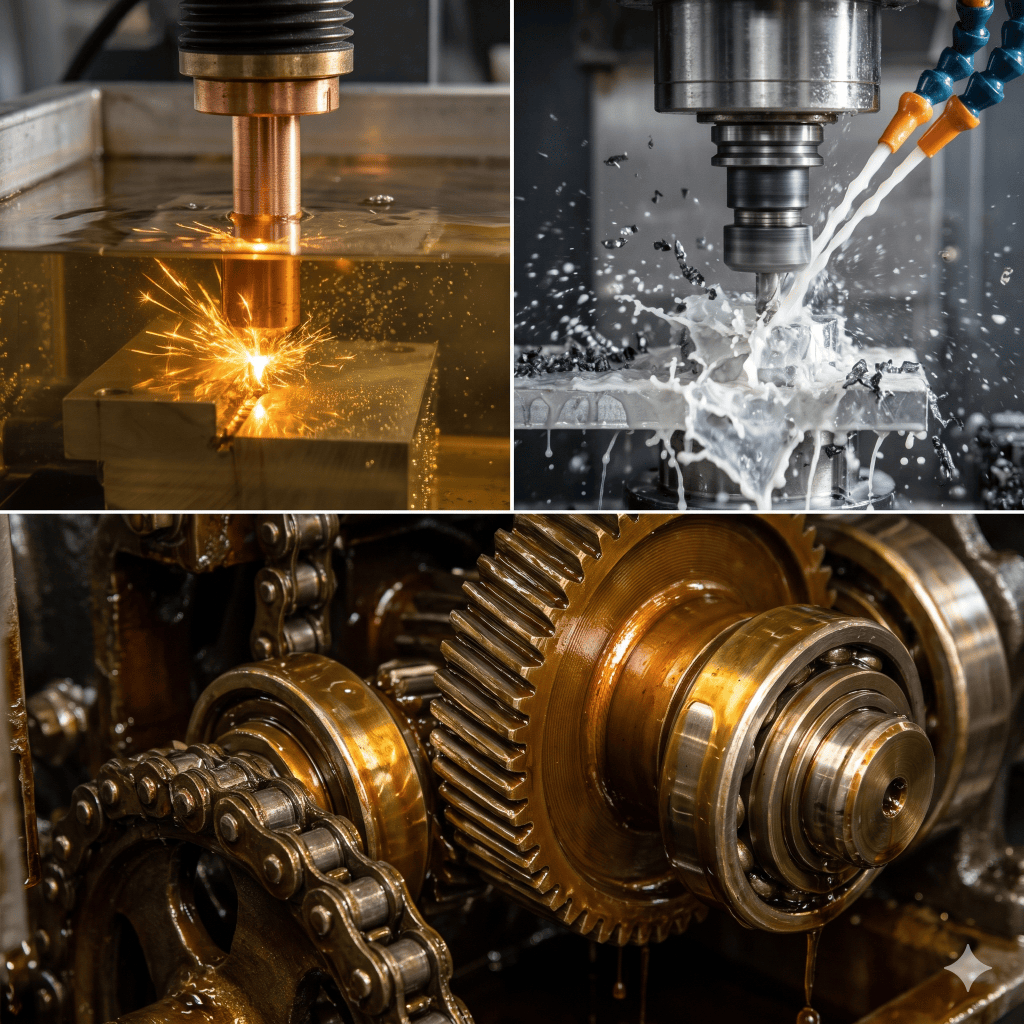
All three are “oils,” but they do completely different jobs. EDM oil is an insulator that controls the spark, cutting oil is a coolant that takes heat away from the tool and workpiece, and lubricating oil is a protective film that reduces wear on moving parts.
We often hear questions on the shop floor like “Can I put leftover cutting oil in my EDM machine?” or “Can hydraulic oil be used instead?” The answer is no. This article explains why.
What each oil does
EDM oil is the dielectric fluid that fills the gap between the electrode and the workpiece. It blocks current under normal conditions and breaks down only when the voltage passes a set level, which is what creates the spark. It also cools the machining zone and flushes away the metal debris melted by each discharge.
Cutting oil is used in turning, milling and drilling, where a tool physically cuts the material. Its job is to reduce friction and remove heat at the high-pressure, high-temperature contact point between the cutting edge and the workpiece. It comes in two types: water-soluble (diluted with water) and neat (used undiluted).
Lubricating oil protects the machine’s own moving parts, such as gears, bearings, slideways and hydraulic systems. It forms a film between metal surfaces to prevent wear and rust, and it is designed to last a long time between changes.
Key differences at a glance
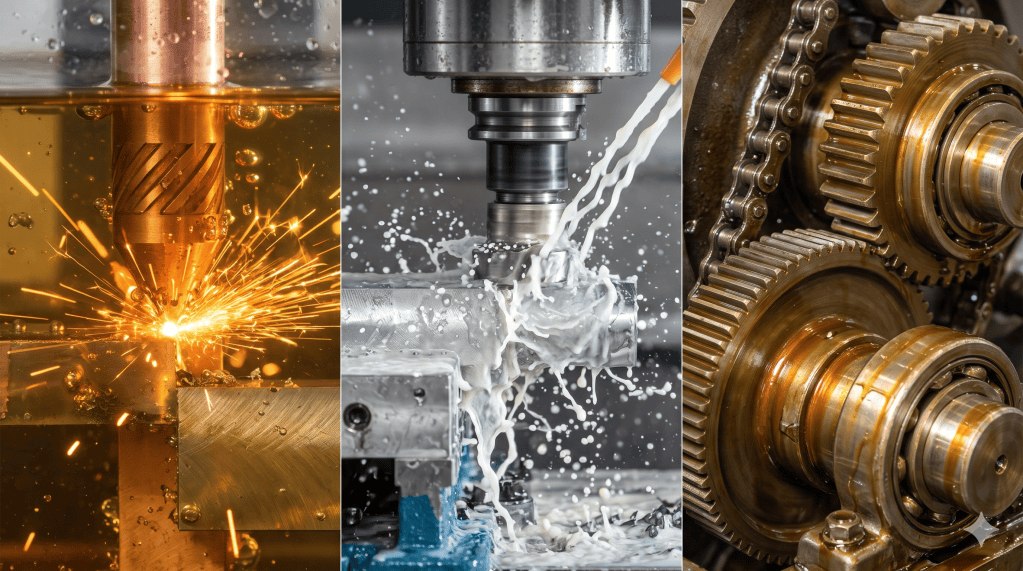
The biggest differences are viscosity and additives. EDM oil must be thin and clean, while cutting and lubricating oils rely on higher viscosity and additives to perform.
| Item | EDM oil | Cutting oil | Lubricating oil |
|---|---|---|---|
| Main role | Insulation, cooling, debris flushing | Friction reduction, tool cooling | Wear and rust prevention |
| Where it is used | Sinker EDM work tank | Lathes, milling machines, grinders | Gears, bearings, hydraulic systems |
| Viscosity (at 40°C, approx.) | Very low, about 2–4 mm²/s | Medium, about 10–40 mm²/s (neat oil) | High, about 32–68 mm²/s for hydraulic oil |
| Dielectric performance | The most important property | Not a design factor | Not a design factor |
| Main additives | None or minimal | Extreme-pressure agents (sulfur, chlorine), emulsifiers | Anti-wear agents, antioxidants, rust inhibitors |
| Aromatic content | The lower the better (less odor and skin irritation) | Varies by product | Varies by product |
| When to replace | Contamination, color change, slower machining | Bacterial growth, concentration change, chip contamination | Oxidation, water ingress, viscosity change |
Viscosity ranges are approximate values for typical products. Check each product’s data sheet for exact figures. Wire EDM machines usually use deionized water rather than oil.
What happens if you use cutting or lubricating oil in an EDM machine
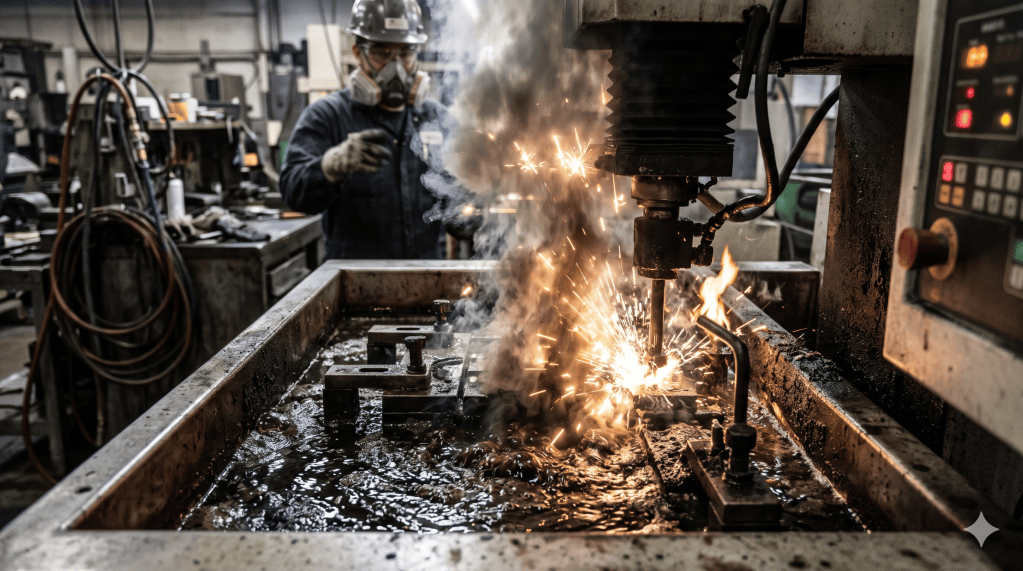
Trying to save on fluid can cost you machining quality, equipment and safety.
- Slower machining: High-viscosity oil cannot flow into the narrow gap between the electrode and the workpiece. Debris stays in the gap and the discharge becomes unstable.
- Arcing and poor surface finish: Built-up debris causes repeated discharges at one spot (arcing), leaving burn marks and pits on the surface.
- Fire risk: The spark zone briefly reaches thousands of °C. Oil without the right flash point and thermal stability can ignite or produce heavy smoke.
- Harmful fumes and odor: The sulfur and chlorine extreme-pressure additives in cutting oil can break down under the spark and release irritating gases.
- Equipment damage: Additives can clog filters or damage seals in the work tank and pumps. Water-soluble cutting oil does not insulate at all because it contains water.
The reverse is also true: EDM oil should not replace cutting or lubricating oil. Its viscosity is too low and it has no anti-wear additives, so it cannot protect tools or machine parts.
How to choose a good EDM oil
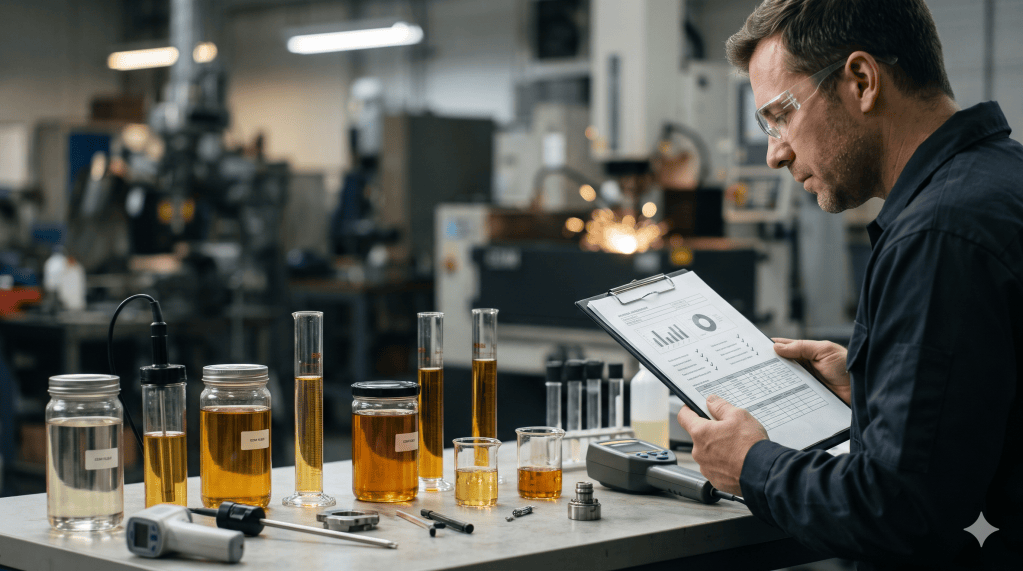
Five items on the data sheet tell you most of what you need to know.
- Viscosity: Lower viscosity flushes debris better and suits precision work. If it is too low, evaporation increases.
- Flash point: A higher flash point is safer against fire, which matters most for unattended overnight machining.
- Dielectric strength: It makes the spark occur exactly where it should, which drives machining accuracy.
- Aromatic content: Lower content means less odor and skin irritation and a better working environment.
- Oxidation stability: The oil keeps its color and performance longer, which extends the change interval.
Rather than comparing unit price alone, look at machining time, electrode wear and change interval together. That shows the real cost.
Conclusion
EDM oil is not just “oil”; it is part of the machining process itself. Replacing it with cutting or lubricating oil can cost you speed, quality and safety.
If you are not sure whether your current fluid suits your machining conditions, contact us at dyna@dynachem.co.kr We will recommend a product that fits your machine and workpiece material and send you a sample.

Dyna Solution Co., Ltd.
Industrial Lubricant Solution
E-Mail : dyna@dynachem.co.kr
Web : dyna.co.kr/en/


답글 남기기